
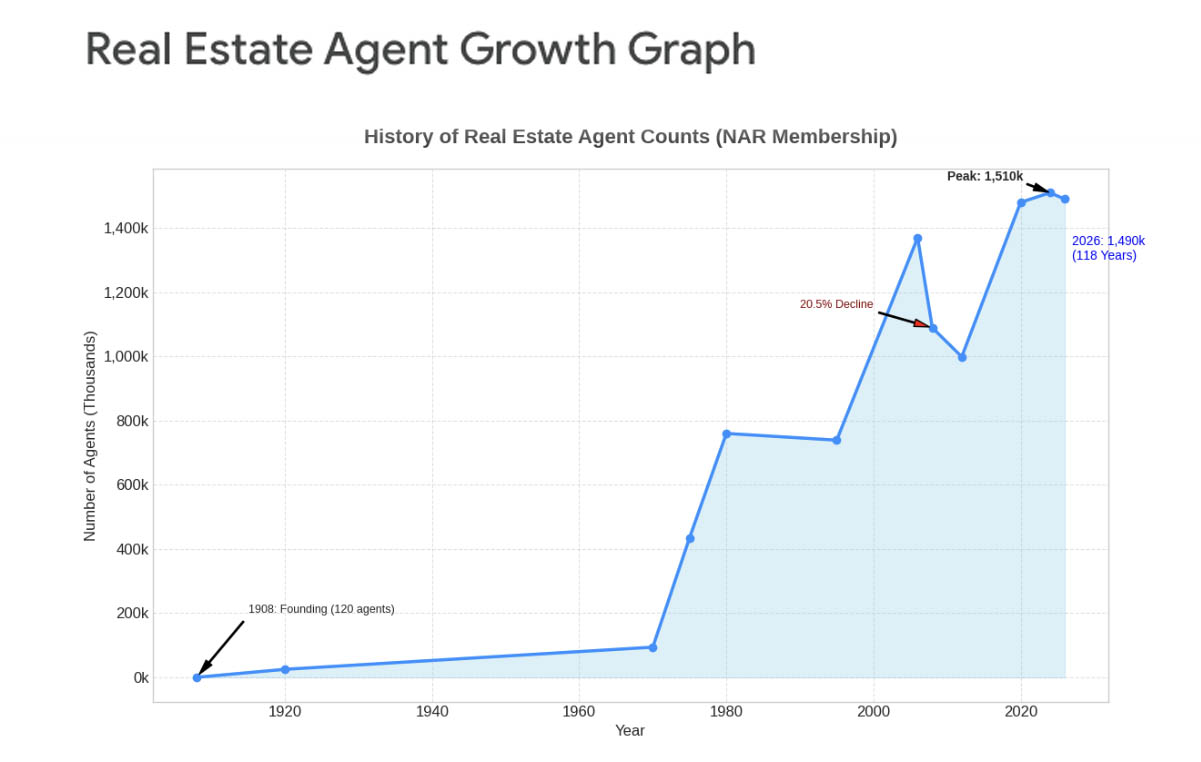
- The Peak: The highest recorded membership occurred in 2024 with 1,510,000 agents.
- The 2008 Correction: Following the 2006 high of 1,370,000, the industry saw a 20.5% decline by 2008, bringing the count down to approximately 1,089,200.
- Historical Scale: The industry has grown from just 120 founding members in 1908 to nearly 1.5 million today— a testament to 118 years of professional evolution.
- Recent Trends: After the 2024 peak, the count shows a slight stabilization at 1,490,000 in 2026.
The Traditional Growth Engine
Historically, the value proposition of a brokerage was centered on three pillars:
- Infrastructure & Brand: Providing a physical office, legal protection, and a trusted name that individual agents couldn’t establish on their own.
- Knowledge Transfer: Training “green” agents in exchange for a high split of their early commissions. This allowed brokers to recoup the high cost of desk space, marketing, and mentorship.
- Lead Generation: Brokers often controlled the flow of leads (via floor time or yard signs), making them the gatekeepers of an agent’s success.
The Shift in the Investment Model
While this model drove the industry to record numbers of licensees, several factors are disrupting the “hire and train” cycle:
1. The Migration of Value
As agents become more sophisticated with their own personal branding and digital lead generation, the “brand” of the brokerage has become secondary. Top-tier producers—the “vital few” who handle the majority of transactions—often feel they are subsidizing the training of new agents without receiving a proportional return in value.
2. Low Barriers vs. High Attrition
The industry has historically relied on a massive top-of-funnel recruitment strategy. However, with the rising costs of technology and shifting commission structures, many brokers are finding it difficult to remain profitable when only a small fraction of new hires become consistent producers.
3. Alternative Models
We are seeing a move away from the traditional “brick-and-mortar” investment toward:
- Virtual/Cloud Brokerages: Minimizing overhead to offer higher splits, essentially “unbundling” the training and office costs.
- The Team Model: Teams within brokerages are now doing the heavy lifting of training and accountability, often more effectively than the brokerage itself.
- Direct-to-Consumer Platforms: New frameworks are attempting to simplify the transaction, questioning whether the traditional “agent-heavy” model is the most efficient way to connect buyers and sellers.
The industry grew through volume and mass recruitment, but the current market seems to be demanding a pivot toward production density—where the focus shifts from how many agents a broker can hire to how much high-level output a smaller, more specialized group can generate.
Do you think the “training” aspect is still a viable investment for brokers today, or has the cost of churn become too high to justify it?
So Where are We Currently?
By mid-2026, several “tectonic” shifts have converged to create this moment:
1. The Post-NAR Settlement Era
The removal of mandatory commission sharing on the MLS has fundamentally decoupled buyer and seller agent compensation.
- The Squeeze: Commissions are no longer a “given.” We’re seeing a rapid move toward unbundled services, where sellers might pay for a “transaction-only” package and buyers are increasingly signing representation agreements with flat-fee or hourly structures.
- The Survival Gate: This is forcing a “flight to quality.” The part-time agent is being priced out, leaving the market to the high-producers who can clearly articulate their value proposition beyond simply “finding the house.”
2. Massive Institutional Consolidation
We are seeing the “Mega-Brokerage” era reach its peak.
- Vertical Integration: Major players like Compass (following the Anywhere acquisition) and Rocket/Redfin are building closed-loop ecosystems. They want to own the search, the mortgage, the title, and the agent relationship in one stack.
- MLS Fragmentation vs. Consolidation: While the number of regional MLSs is plummeting, the remaining ones are becoming more powerful, often operating more like tech companies than trade associations.
3. From HI to “Augmented HI”
The conversation has shifted from “Will AI replace agents?” to “How do the top 1% of agents use AI to scale their Human Intelligence (HI)?”
- Warm Engagement: Predictive analytics are now standard for identifying “likely-to-sell” households, allowing the elite producers to ditch cold calling in favor of data-backed, high-probability outreach.
- Transaction Automation: Middle-office tasks (scheduling, compliance, basic lead nurturing) are being offloaded to AI, allowing the “Vital Few” to focus entirely on high-level negotiation and relationship management.
4. The Rise of Direct-to-Consumer (DTC) Logic
There is a growing segment of sophisticated buyers and sellers looking for a Peer-to-Peer (P2P) experience. They want the discovery and validation process to be as frictionless as a modern fintech app, removing the “gatekeeper” friction while still having access to an expert advisor when the deal gets complex.
The “institutional middle” is effectively hollowing out. We’re moving toward a bifurcated industry: high-volume, tech-heavy discount platforms on one side, and highly specialized, high-intelligence advisors on the other.
Where do you see the biggest friction point in this new landscape—is it the consumer’s perception of value, or the sheer speed of the technological turnover?
Surviving the Great Depression
Real estate agents survived the 1929-1939 Great Depression by navigating a period of severe market contraction characterized by plummeting property values and record-high foreclosure rates.
Surviving the GFC in 2008
During the 2008 real estate crash, many agents faced sharp revenue drops as transactions halted amid foreclosures and plummeting prices.